Git for Humans from A Book Apart
I’ve been creating web stuff for over 10 years, and i’ve been working with Git for probably the last 4 or 5 of those. So I consider myself relatively rote in basic Git commands like commit, push, pull, etc. However, I’ve never felt like I really understood Git, so I grabbed this book thinking it might help. One of the more lasting impressions this book left me was a concept introduced in the preface of the book by Mandy Brown:
Knowing when and how to commit a change is more than just a means of updating code—it’s also a practice for communicating and sharing work. ... By all means, devour the following chapters in order to t understand how to manage merge conflicts and interpret a log. But don’t forget that Git’s ultimate audience isn’t machines—it’s humans.
This idea of looking at Git as a communication tool is reinforced throughout the entire book. Git can be seen as a way to tell a story about what’s happening to your codebase in a way that’s much “closer to the metal” than other communication tools Slack or email. It’s made me rethink my actions in Git, like how I craft commit messages, how I tag branches, and how I propose and merge pull requests. These can be viewed as more than commands in the terminal but as methods of communicating to humans in the story book of a project, Git becomes a powerful tool of communication over the life arc of your codebase.
For example, when I was first introduced to Git I thought it rather laborious. I liked the idea of saving changes often but having to write a message for every save? That seemed a bit much. Which is why my commit history looked something like:
Initial work on sidebar widgetmore changesstill more changeslast changeok this is the last change
Now after reading this book, I want to be more thoughtful in my approach to Git and commit messages. I want to have the change of mindset the author himself had and describes in the book:
I came to appreciate the benefits of having every signification version of my projects stored, annotated, and neatly organized ... [it helped me] to think of commits as significant changes, as opposed to the hundreds of little changes I might save in a given hour. The extra steps involved in committing ... have ultimately helped me develop a more thoughtful and judicious way of working.
I think if you work in Git long enough, you’ll begin to appreciate how all those little commits and actions stack up over the course of a project. To have a couple year-old project that is beautifully documented in Git is something you’ll never get through shortcuts. You’ll only get it through disciplined, thoughtful work over a long span of time. Chris Beams talks about this in his article “How to Write a Git Commit Message”. He begins by showing two examples of commit histories, one earlier in his project when he wasn’t caring about commit messages and the other later in the project when he began caring:
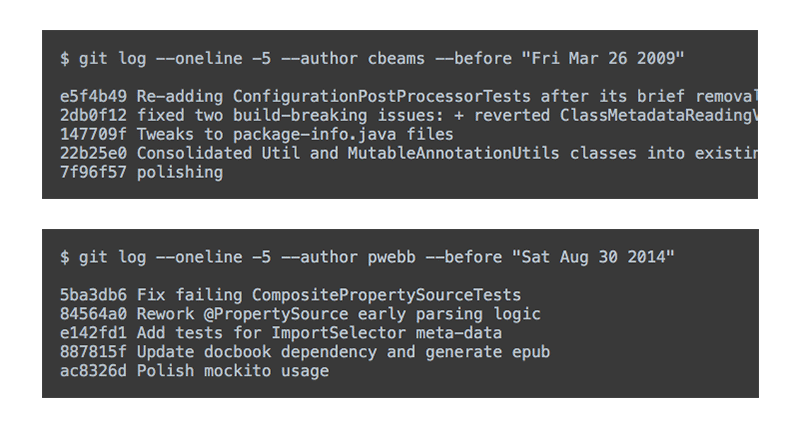
The former varies wildly in length and form; the latter is concise and consistent. The former is what happens by default; the latter never happens by accident.
If you’ve worked in software, you know the truth of those words: “the former is what happens by default, the latter never happens by accident”. The author of “Git for Humans” touches on this same point in his book:
Every commit you add to your repository contributes to the historical record of your project, so it’s a good idea to make the best, most meaningful commits you can.
That’s what I enjoyed most about this book. I didn’t come away with a lot of technical tips and tricks on using Git (though I’m sure as a newbie to Git you could gain precisely that). Rather, I came away with a broader view of Git as a tool and a process. Git can be about version control, yes. But it can also be about regular people making changes, evolving a code base, crafting a history, and doing it all together. Git can be a story, the story of your time with other people on a project, a biography of yourself, your team, and your product.